STAR Method for Interviews: How to Answer Any Behavioural Question
"Tell me about a time when" is a scored question with a marking sheet, and rambling is how good candidates fail it. The four-part structure that keeps you safe, two worked examples, and the five stories that answer almost every behavioural question in Indian interviews.
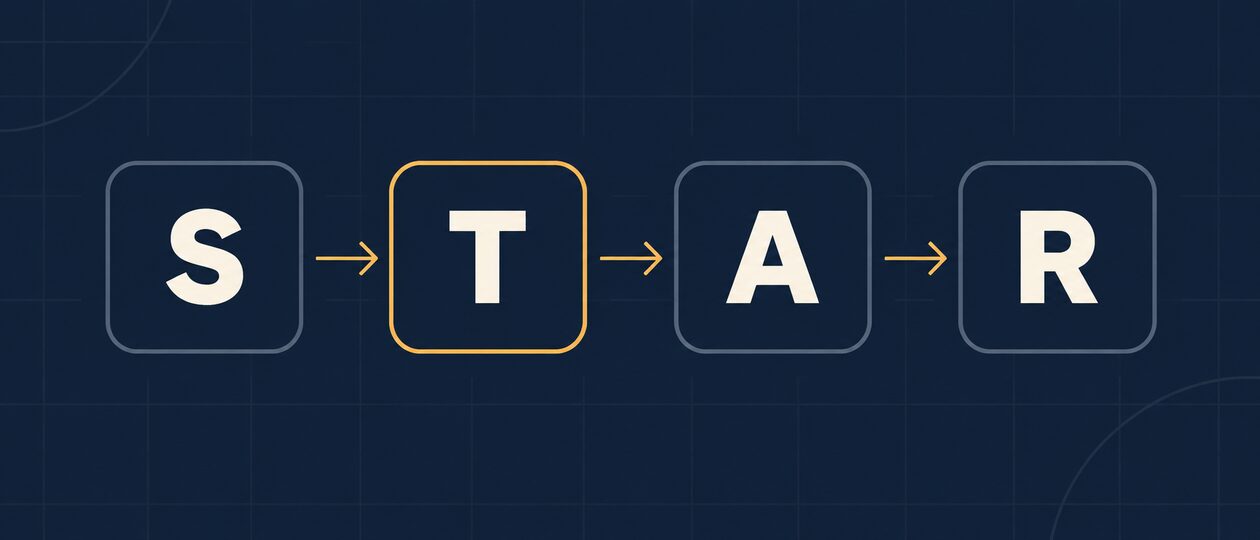
"Tell me about a time you disagreed with a teammate." Most candidates hear this as the start of a conversation. It is not. It is a scored question. The interviewer has a sheet in front of them, there is a column for structure and a column for ownership, and the next ninety seconds decide what gets written in them.
The candidates who fail these questions are rarely unqualified. They ramble. They spend two minutes setting up context, thirty seconds on what actually happened, and never say what came of it. The interviewer stops listening somewhere in minute one and the column stays blank.
The STAR method exists to stop that. Situation, Task, Action, Result. It is not a trick and interviewers are not fooled by it - it is simply the order their sheet expects the answer in. This guide covers what the sheet is really scoring, how to split your ninety seconds, two worked examples you can adapt, and the five stories that between them answer almost every behavioural question asked in Indian interviews.
What the interviewer is actually scoring
Behavioural questions show up everywhere in Indian hiring. Services companies ask them in the HR and managerial rounds. Product companies and GCCs run a dedicated behavioural or "leadership principles" round. Even campus placements, where the process is compressed into one day, keep a version of them for the final HR sitting.
Behind the question is usually a short rubric. It varies by company, but the columns are some mix of these:
| What the sheet says | What it actually means |
|---|---|
| Communication | Can you tell a story in order, without being steered? |
| Ownership | Do you say "I did this" or hide inside "the team"? |
| Self-awareness | Do you know what you got wrong? |
| Judgement | Did you make a sensible call under constraint? |
| Coachability | Did you learn something you can name? |
Notice what is missing: the outcome of the story itself. Nobody's sheet has a column for "did the project succeed". A story about a failed college event can score full marks if it is structured, owned, and ends in a lesson you can articulate. A story about a successful product launch can score zero if it is a five-minute fog with no decision in it.
This is also why memorised answers from the internet fail. The interviewer is not comparing your story to other stories. They are checking whether your story has the parts their sheet needs. Our HR interview questions guide covers the wider question set; this piece is about the structure that scores well on the behavioural subset, which is usually asked right after tell me about yourself.
The four parts, in the right proportion
Here is the split that works, for a ninety-second answer:
| Part | Share of your answer | Its only job |
|---|---|---|
| Situation | 10-15% | Give just enough context for the story to make sense |
| Task | 5-10% | Name the specific thing that was yours to do |
| Action | 55-65% | What you did, step by step, in the order you did it |
| Result | 15-20% | What happened, with a number, plus what you learned |
Situation: two sentences, no more
When, where, and what was at stake. "In my third semester, four of us were building the event app for our college fest, and two weeks before launch our backend person stopped showing up." That is a complete situation. It does not need the history of the fest, the name of the app, or what the app was supposed to fix. Every sentence of context you add is a sentence of action you delete.
Task: one sentence
What was your specific responsibility inside that situation - not the team's goal, yours. "My job was the registration flow, and with him gone, the payment integration had nobody on it." If you cannot say your task in one sentence, you do not yet know what your task was, and the interviewer will notice.
Action: the part everyone underweights
This is where the marks are. Describe what you did in the order you did it, with real detail: what you considered, what you ruled out, who you spoke to, what you built. Use "I", not "we". "We decided" tells the interviewer nothing about you; "I proposed splitting the payment work into three pieces and I took the two hardest" does.
Detail is what makes a story believable. Anyone can say "I handled the situation". Only someone who was there can say "the first thing I did was read his last three commits, because whatever was broken was probably in them".
Result: a number, then a lesson
End on what changed, stated concretely. Registrations opened on time. The bug rate dropped by half. We shipped two days late and here is why. If you have a number, use it. If you do not, name the observable outcome.
Then add one sentence of learning: "what I took from that was that I should have raised the risk the week before instead of absorbing it quietly." That sentence is what turns a story into evidence of coachability, and coachability is the column most candidates leave empty.
Interviewers do not remember your story. They remember whether your story had an ending.
Worked example: the fresher version
Here is a full answer to "tell me about a time you had to learn something quickly", built from the fest story above. Notice the proportions.
"In my third semester, four of us were building the event app for our college fest, and two weeks before launch our backend person dropped out. My job had been the registration flow, and suddenly the payment integration - the piece that collected entry fees - had nobody on it.
I had never touched the payment gateway's API. So I gave myself three days to learn just enough of it. I read the gateway's sample code rather than the full documentation, built a tiny test page that did nothing but accept one rupee, and got that working by day two. On day three I wrote the real integration, copying as little as possible from the sample so I actually understood each step. When two edge cases broke - failed payments that still showed as successful - I asked a final-year senior to review my error handling for half an hour, and his one comment about verifying server-side fixed both.
We launched on time. The app handled about 1,400 paid registrations over the fest weekend, with two failed-payment complaints, both resolved manually in a day. What I learned was that asking for a review is faster than debugging alone, and I have not been shy about it since."
Ninety seconds. Situation two sentences, task one, action half the answer, result with numbers, learning at the end. If you are preparing for placements, our campus placement preparation guide shows where this fits in the full day, and the project you use here should also be written properly on your resume - the resume projects section piece covers that.
Worked example: two years into a job
The same skeleton works for people switching jobs. Question: "tell me about a time you disagreed with your manager."
"At my last company, a support tool, I owned the weekly report that went to the operations head. My manager wanted to add six new metrics to it, two days before it was due to leadership, and I thought the additions would bury the one trend that mattered - repeat tickets, which had been climbing for a month.
I did not push back in the meeting. I went away, rebuilt the report both ways, and booked twenty minutes with him the same afternoon. I showed him that with the six additions, the repeat-ticket trend moved to page two, and that the previous quarter's review had specifically asked us to watch it. I proposed keeping his six metrics in an annexure. He agreed to three of the six, dropped the rest, and the repeat-ticket line stayed on page one.
The next monthly review, leadership acted on that trend and staffing on the worst queue was increased, which brought repeat tickets down roughly 18% over the following quarter. What I took from it: disagree with data and an alternative, not with a feeling - and do it in private, not in the room."
Notice that the story is small. No heroics. That is what makes it usable: you can tell it calmly, and every line survives a follow-up question.
Five stories cover almost every question
You do not need twenty stories. You need five, each of which can be re-angled to fit three or four different questions.
| Story to prepare | Questions it can answer |
|---|---|
| Something you built or fixed that was hard | Tight deadline; learning something fast; proudest achievement |
| A conflict with a peer or senior | Disagreement with manager; difficult teammate; convincing someone |
| A real failure or mistake | Biggest weakness; a time you failed; what would you do differently |
| A time you led without the title | Leadership; taking initiative; handling a crisis |
| A time you went beyond your assigned work | Going the extra mile; why should we hire you; handling ambiguity |
The re-angling is the skill. The fest story above answers "learn something fast", but with the emphasis moved it also answers "handle a teammate leaving" (conflict and ownership) and "work under deadline pressure" (two weeks to launch). Same facts, different Task sentence. Write your five stories once, then practise re-pointing each one at three different questions.
Two cautions. Questions about employment gaps and salary play by different rules - keep those separate, and see our pieces on explaining an employment gap and the expected CTC question. And do not use STAR on technical questions; when someone asks you to design a system, they want the design, not a story arc.
Where candidates get STAR wrong
Eighty per cent Situation. The most common failure. If you are ninety seconds in and have not reached anything you did, the interviewer has already scored you.
"We" instead of "I". Team stories are fine as setting. The Action section must be yours alone. If everything was done by "we", the interviewer cannot tell whether you led the work or watched it.
A result with no ending. "And it went well" is not a result. Numbers are best, but any concrete observable outcome works: it shipped, the complaints stopped, the client renewed.
Memorising the script. Interviewers follow up: what would you do differently, what was the hardest part, what did the other person say? A recited answer collapses on the first follow-up. Prepare the story beats, not the sentences.
Inventing the story. Panels probe details for exactly this reason, and a fabricated story rarely survives two questions about specifics. If you genuinely have no story for a question, say so and offer the closest real one you have - that is received far better than fiction.
A drill for the week before
- Write your five stories, one per row of the table above. Bullet points, not paragraphs.
- For each story, mark the four beats - S, T, A, R - and check the proportions. If Situation is more than three lines, cut it.
- Say each story aloud, timed. Sixty to ninety seconds. Recording yourself on your phone is uncomfortable and worth it.
- Have a friend ask one follow-up after each story. "What would you do differently?" is enough.
- Practise re-angling: take one story and tell it for a failure question, then a leadership question, then a deadline question.
Delivery matters as much as structure here - pace, clarity, not rushing the ending. Our notes on English communication for interviews cover that side of it.
The candidates who clear behavioural rounds are not the ones with the most impressive stories. They are the ones whose stories have a shape the interviewer can score: a real situation, one clear task, actions they can own, and an ending with a number in it. Build five of those and the question stops being something to fear.
Frequently asked questions
Is the STAR method only for HR rounds?
No. Managerial rounds and leadership or behavioural rounds in product companies use the same questions with a sharper eye. It does not apply to technical or coding rounds, where the answer is the work itself, not a narrative about the work.
What if I honestly have no story for a question?
Say so in one line, then offer the nearest real thing: "I have not faced exactly that, but here is the closest situation I have been in." Interviewers accept this readily. What they do not accept is an invented story, and they test for it with follow-ups.
Can the Result be a failure?
Yes, and sometimes it should be. For "tell me about a time you failed", the expected structure is the same - the only change is that the Result is the miss plus what you changed afterwards. A failure story with a clear lesson scores better than a success story with a vague one.
How long should a STAR answer be?
Sixty to ninety seconds for the first telling. Then stop and let the interviewer pull threads. If they want more, they will ask, and each follow-up answer can be another twenty to thirty seconds. Two uninterrupted minutes is too long no matter how good the story is.
Can freshers use college examples?
Yes. Projects, fests, internships, part-time work, even organising something in your housing society. Nobody expects corporate stories from a fresher. They expect structure, ownership and honesty, and a college example supplies all three if you tell it in order. Newer formats like AI interview questions follow the same rule: real and specific beats impressive and vague.